
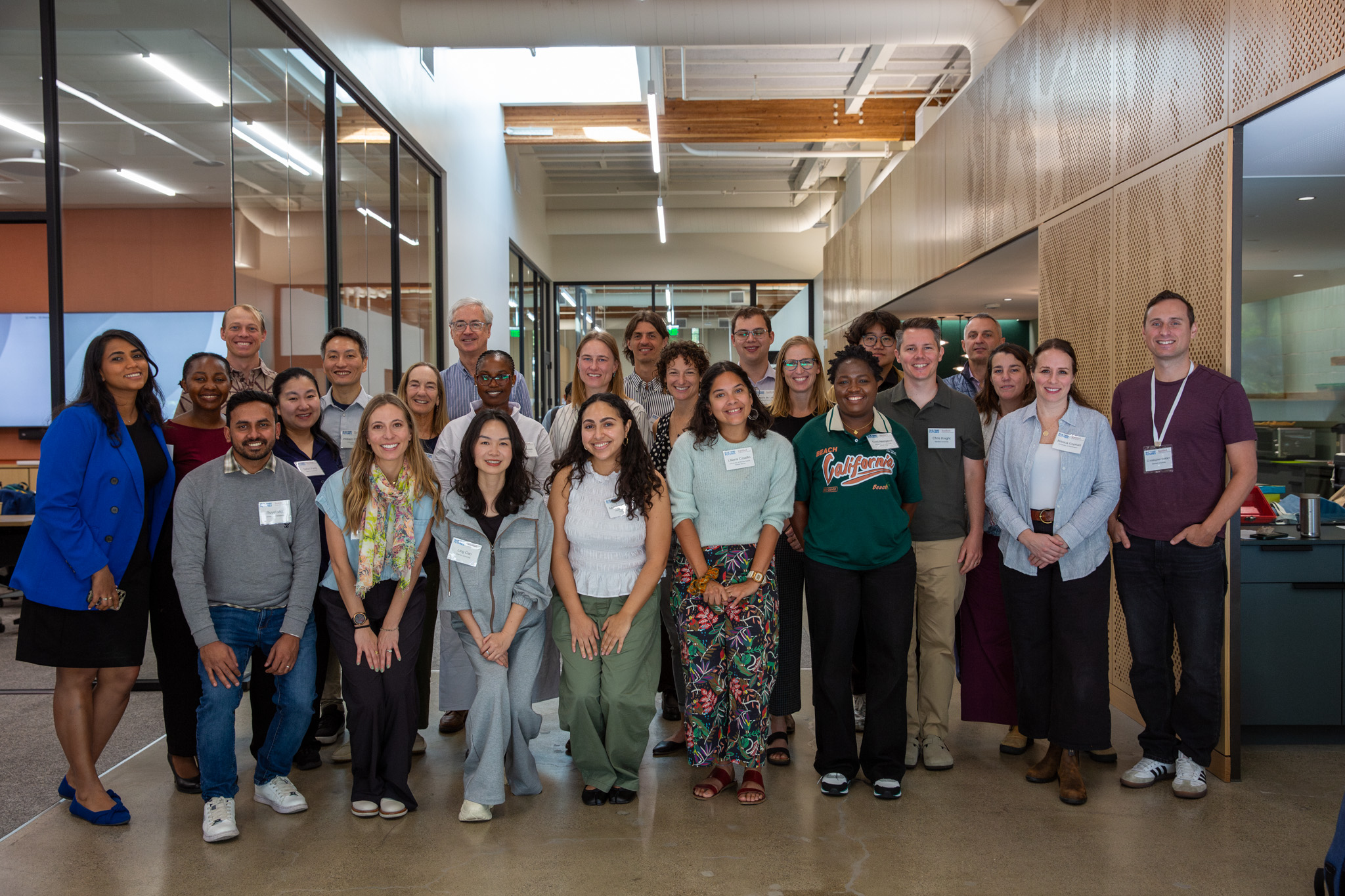
In brief:
- The Stanford Center for Ocean Solutions hosted a two-day workshop for members of the global Blue Food Futures Program to explore opportunities for transforming the sector.
- Participants discussed emerging research priorities in blue food transformations, global trade and small-scale fisheries production, and climate-resilient futures.
- The workshop featured four early-career fellows who highlighted blue food research underway in Bangladesh, Honduras, Puerto Rico, Kenya, and South Africa.
According to the latest United Nations projections, global food systems will need to sustain a population of over 9 billion by 2050. Many people addressing this challenge, whether in research, policy, or practice, think primarily in terms of crops and livestock, even though seafood is an essential source of nutrition for 3 billion people.
A growing contingent of researchers has set out to change that approach. Members of the Blue Food Futures Program gathered on the Stanford campus in March 2026 to outline a vision for ensuring that research on the fisheries and aquaculture sectors, or blue foods, gains greater prominence in policy discussions shaping the future of food.
“For all the research being done in fisheries and aquaculture, it’s largely disconnected from discussions about the future of food systems,” said Jim Leape, co-director of the Stanford Center for Ocean Solutions and chair of the program’s policy committee. “We’re working to build a bridge between these two worlds.”
The convening included leading experts in global trade, small-scale fisheries production, climate change, blue food transformations, and related topics. Together, they comprise three scientific working groups of the Blue Food Futures Program, which brings together scholars from across the world to investigate key scientific questions and accelerate policy-relevant research.
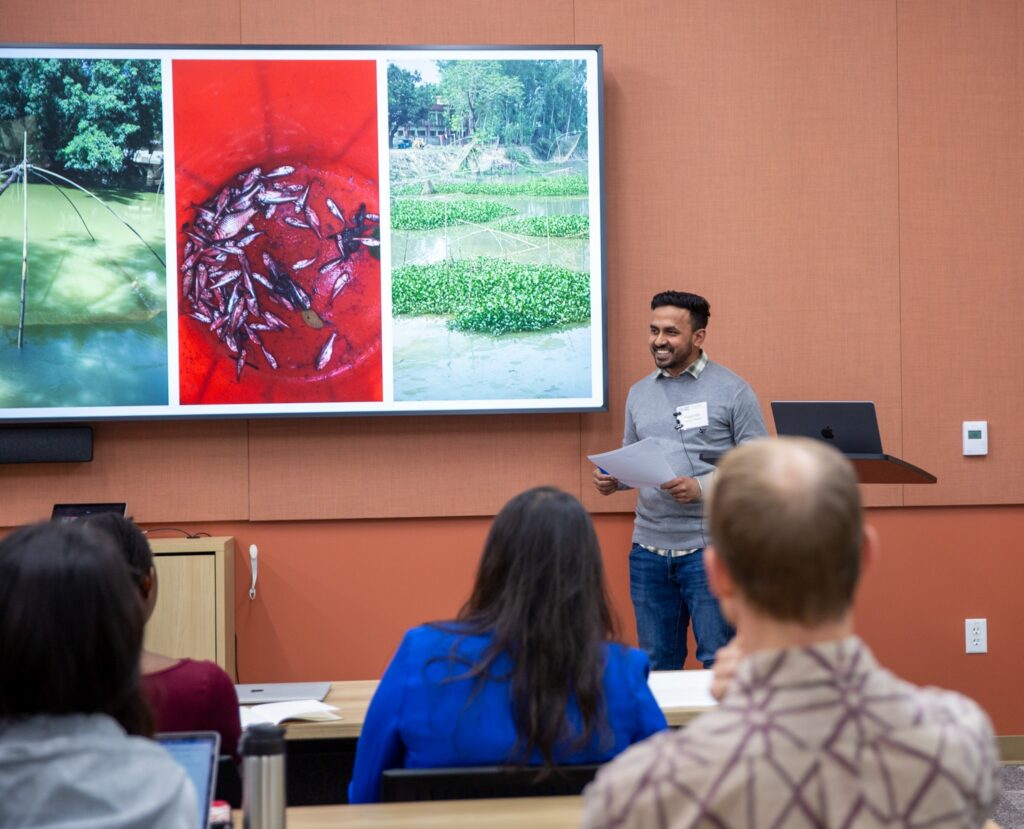
“I stand here, a boy from a small village where the local river is a lifeline for thousands of people, because I believe in fair approaches to managing blue foods,” said Ruyel Miah, a 2026 Blue Food Futures Fellow based at the University of Waterloo. “The fishing communities in my home country of Bangladesh have never heard of Stanford or the Blue Food Futures Program, but they are the reason why I am here today. I commit to amplifying their voices.”
The workshop delved into some of the most pressing issues facing the blue food sector today, such as accounting for the outsized contributions of small-scale fishers, which produce over half of the world’s catch, to the global economy. Miah, who grew up in a fishing village, studies how new policy approaches could improve shared governance of the Sundarbans, a vast mangrove and wetland system spanning Bangladesh and India that supports blue food livelihoods.
Discussions also highlighted the need for new evidence-based analyses of aquaculture, fisheries, and value chains to support the United Nations Food and Agriculture Organization’s vision for transforming aquatic food systems. In addition, participants explored how systematic analyses of successful case studies of emerging innovations could demonstrate how community- and regional-level efforts are protecting blue foods, including their vital contributions to nutrition and livelihoods, in the face of climate change.
“A central aim of the Blue Food Futures Program is to not only accelerate blue food research, but also shape the sector’s trajectory,” said Program Manager Josheena Naggea. “A highlight of the workshop was hearing from four Blue Food Futures Fellows whose early-career research grounds global insights in local contexts and helps inform fairer approaches to managing the sector. They represent the future of blue food research.”
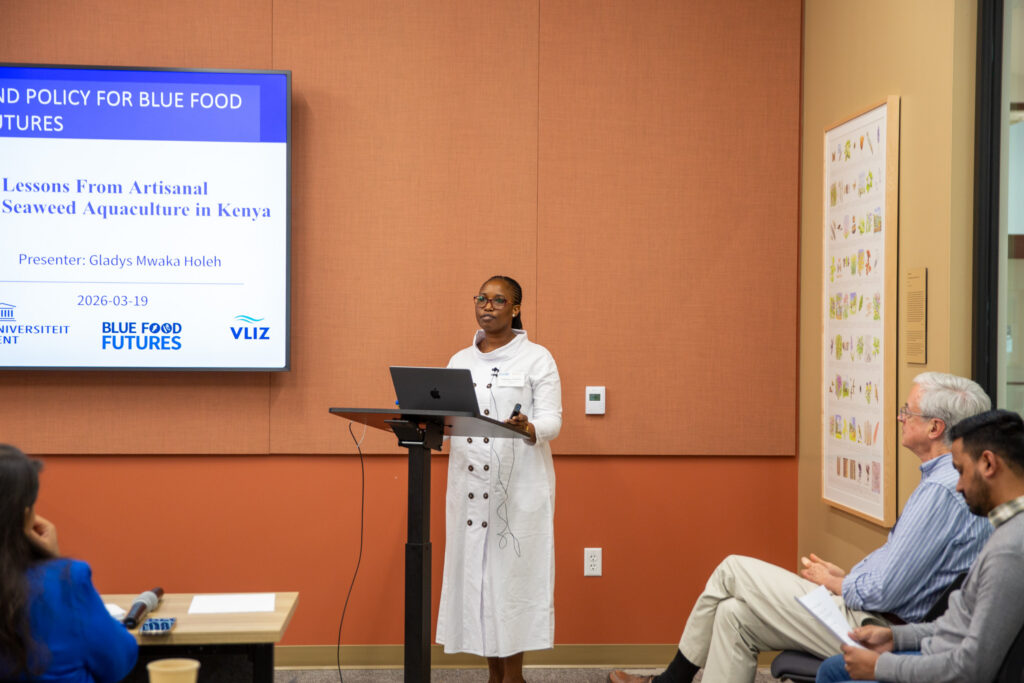
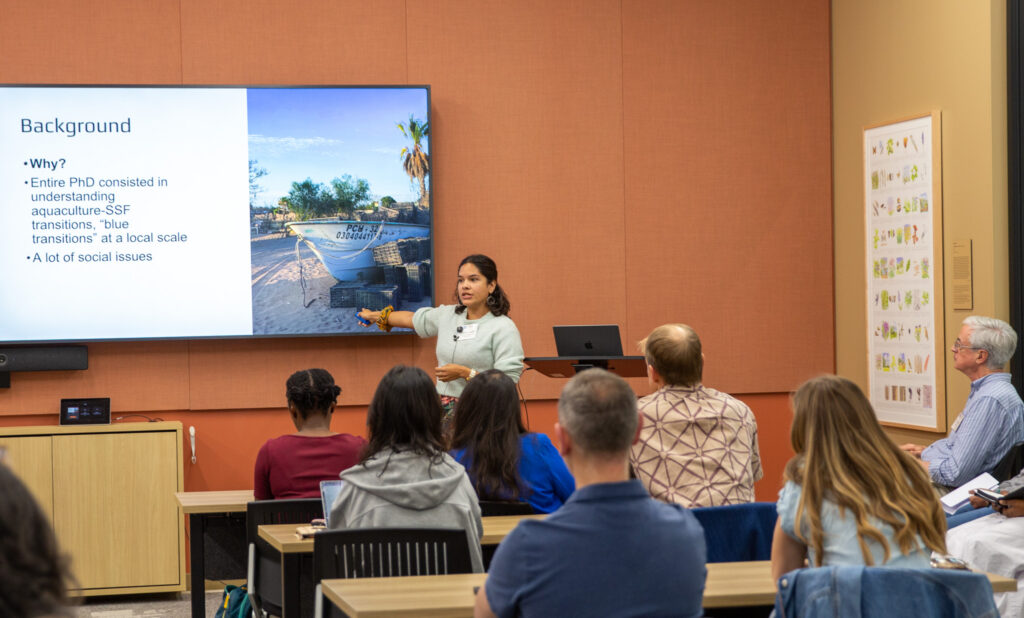

| “Seaweed farming is not just about production, but who gets access to resources,” said 2026 Blue Food Futures Fellow Gladys Mwaka Holeh, who researches how government reforms could enable greater participation of coastal communities in seaweed value chains in Kenya. (Image credit: Belle Long) | “We usually think of oceans, coasts, and land as separate systems, but in many countries, people understand them as interconnected,” said 2025 Blue Food Futures Fellow Lilliana Sierra Castillo, who studies communities in Honduras and Puerto Rico that rely on both fishing and agriculture for nutrition, income, and cultural identity. (Image credit: Belle Long) | “Marine resource planning is often shaped by individuals who already have ideas of how the ocean ought to be used,” said 2025 Blue Food Futures Fellow Aphiwe Moshani (on screen), who studies how community participation is central to the development of ocean economies, including the blue food sector. (Image credit: Belle Long) |
Blue Food Futures is an endorsed program of the UN Ocean Decade of Ocean Science for Sustainable Development. The program strengthens blue food science, policy, and community, and is a collaboration between the Stanford Center for Ocean Solutions, Stockholm Resilience Centre at Stockholm University, Environmental Defense Fund, Government of Iceland, WorldFish, National Center for Ecological Analysis and Synthesis, University of British Columbia, and Xiamen University.